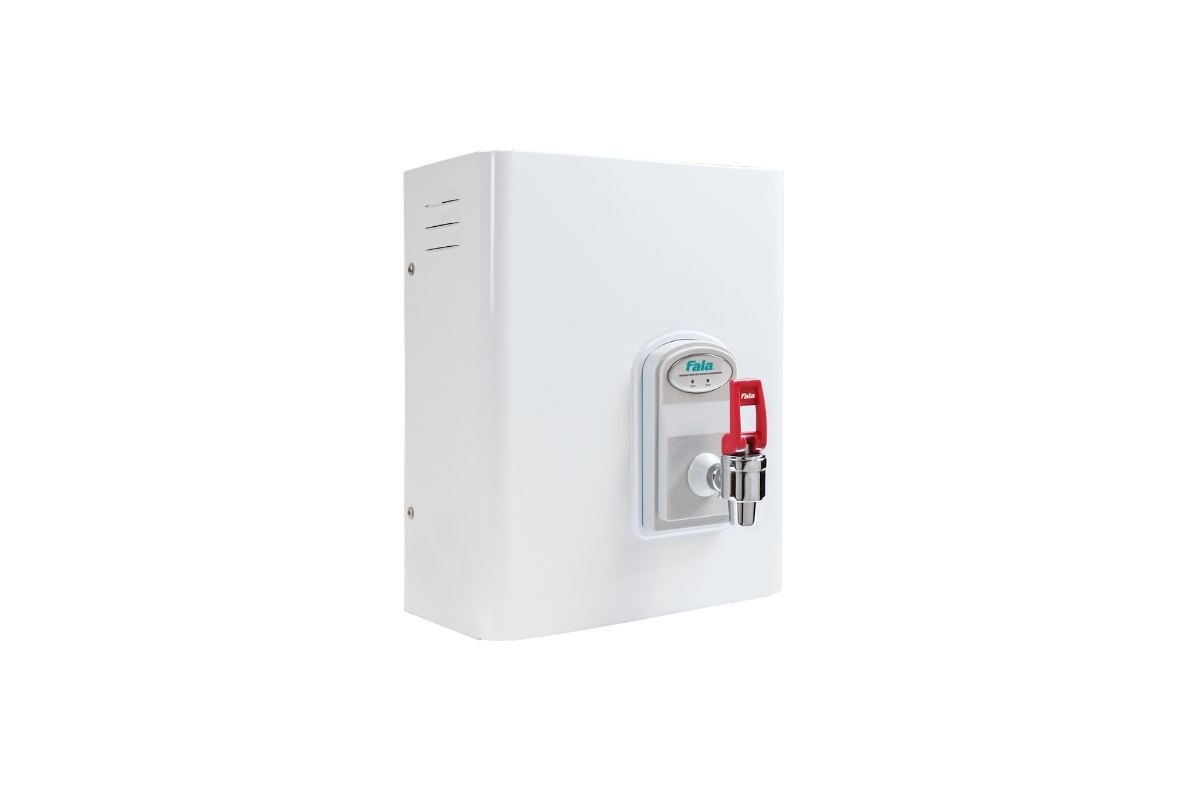
To keep your unit running efficiently and to be covered by warranty you must understand your water quality and follow required service intervals. Refer to the manual more details.
Visible white or chalky deposits on the heating element, level probes or internal components may indicate mineral build-up. You may also notice slower heat-up times, inconsistent filling or nuisance alarms. These issues are more common in harsh water areas.
Service frequency depends on water quality.
Harsh water areas = every six months
Normal water areas = every 12 months
Have a qualified technician service the unit every six months, including inspection of key internal components such as the inlet strainer and water level sensor.
At Fala we assess water quality using the Langelier Saturation Index (LSI). At operating temperature, normal balanced water falls between –0.3 and +0.3, while harsh water falls outside that band but still within warranty limits (≥ −1.0 and ≤ +0.8). Harsh water increases the risk of scale and corrosion and may require more frequent servicing.
If you’re in a harsh water area, installing an auxiliary filter and increasing your servicing frequency can help protect your unit. You should also regularly check for residue or debris on components like the inlet strainer. If you’re unsure about local water quality, contact your state water authority or local council.
Proper water quality protects the internal components of the boiler – especially the heating element, water level probes and inlet filter. Poor water quality can cause scale, corrosion and fouling, which lead to slow heat up times, increased energy use and premature component wear.
On This Page
OVERVIEW
SPECIFICATIONS
DOWNLOADS
APPROVALS & CERTIFICATIONS
FEATURES
FAQS
To keep your unit running efficiently and to be covered by warranty you must understand your water quality and follow required service intervals. Refer to the manual more details.
Visible white or chalky deposits on the heating element, level probes or internal components may indicate mineral build-up. You may also notice slower heat-up times, inconsistent filling or nuisance alarms. These issues are more common in harsh water areas.
Service frequency depends on water quality.
Harsh water areas = every six months
Normal water areas = every 12 months
Have a qualified technician service the unit every six months, including inspection of key internal components such as the inlet strainer and water level sensor.
At Fala we assess water quality using the Langelier Saturation Index (LSI). At operating temperature, normal balanced water falls between –0.3 and +0.3, while harsh water falls outside that band but still within warranty limits (≥ −1.0 and ≤ +0.8). Harsh water increases the risk of scale and corrosion and may require more frequent servicing.
If you’re in a harsh water area, installing an auxiliary filter and increasing your servicing frequency can help protect your unit. You should also regularly check for residue or debris on components like the inlet strainer. If you’re unsure about local water quality, contact your state water authority or local council.
Proper water quality protects the internal components of the boiler – especially the heating element, water level probes and inlet filter. Poor water quality can cause scale, corrosion and fouling, which lead to slow heat up times, increased energy use and premature component wear.
RELATED PRODUCTS